Why Flake Ice?
Flake ice is the most cost effective type of ice to use for cooling fresh caught fish, broiler and poultry chilling, cooling concrete for mass concrete pour projects, cooling and transporting of produce such as corn and broccoli, and food processing, such as meat processing and commercial bakery applications.
Expandable Question Tabs
 FASTER COOLING
Flake ice has more than 17,000 sq. ft. (1,579 sq. meters) of surface area per ton of ice, providing greater cooling efficiency than any other ice.
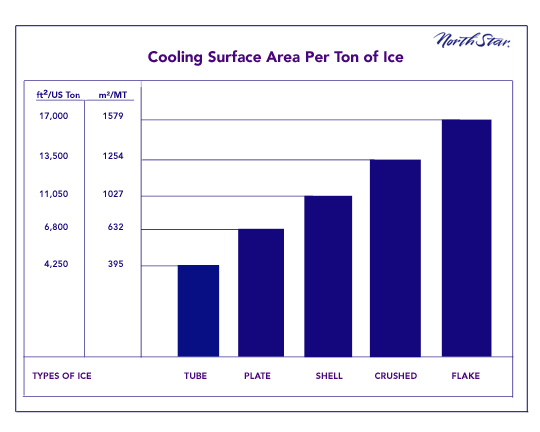
BETTER PRODUCT COVERAGEFlake ice is formed in dry, flat flakes which flow freely and provide greater contact area than any other type of ice. These thin flakes melt quickly to cool products efficiently. Heat transfer occurs when ice melts, so the faster ice melts, the faster it draws heat from your product and the faster it cools.
THOROUGH PRODUCT MIXINGFlake ice melts rapidly to dissipate heat and add moisture to mixtures. This aids the blending process and will not damage mixing equipment.
GREATER PRODUCT PROTECTIONFlake ice packs well and cushions products against damage. Its flat shape will not create indentations or cause bruising of perishable products.
COST-EFFECTIVE PRODUCTIONFlake ice is economical to produce, requiring only 1.3 tons of refrigeration (TR) per ton of ice (5 kW of refrigeration per metric ton) from 60ºF (16º C) water. Unlike other types of ice making, flake ice does not require a defrost cycle, so it uses less energy and requires a smaller refrigeration load.
BETTER SANITATIONFlake ice is not exposed to ambient conditions or mechanical handling from the time it is produced until it goes into storage. Therefore, it is more sanitary than types of ice which require more mechanical and human handling.
EASIER STORAGE AND DISTRIBUTIONFlake ice is sub-cooled, so it is completely dry. Since there is no free water as with other types of ice, flake ice will not fuse together in a storage bin or clog delivery systems. During storage it forms a thin surface crust, which preserves the ice for use at a later time. Dry, free-flowing ice flakes are available for immediate use by simply breaking the crust.
BEST FOR HIGH VOLUME APPLICATIONSFlake ice is uniquely suited for high volume applications. Ice produced using a defrost cycle, such as shell, tube or plate ice, carries a lot of free water with it into the storage bin. This water creates problems with corrosion, bacteria growth and iceberg formation in the bin.
NO WASTED WATERFlake ice makers recycle all unfrozen water back to the ice maker so no water is wasted. This ensures that all water is converted to ice and conserves water resources.
Helpful Technical Information
Use the Capacity Calculator below to size the correct ice maker for your project. Download helpful brochures, specification sheets, and other technical data in our Resources Library.
 Capacity Calculator
 Resources